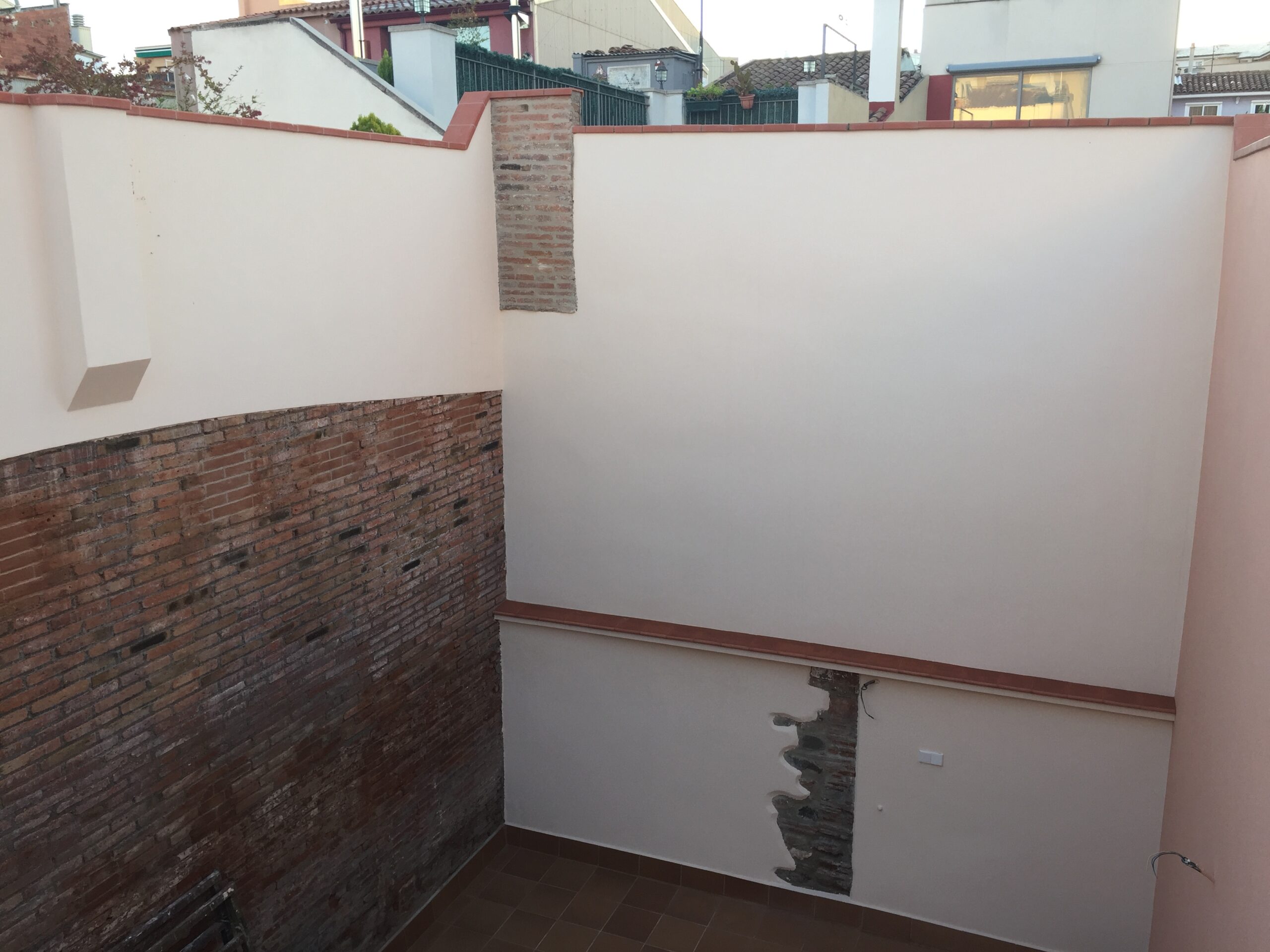
Rising damp is moisture that rises from the ground up through the walls. Brick, stone and mortar have tiny pores through which water climbs as it would in a sponge, and it does so continuously: it does not depend on rain or the season.
It is the typical problem of ground floors, commercial premises and basements in old buildings, which were built without a barrier separating the wall from the moisture in the ground. In Barcelona and in the old town centres of the Vallès we see it every day.
How to recognise it
- Patches on the lower part of the walls, with a more or less horizontal edge.
- Salt deposits: white powder or crusts on the surface.
- Paint and plaster that bubble, flake or crumble.
- Damaged plinths and skirting boards, and a musty smell.
- The patches look the same in summer as in winter, whether it rains or not.
If the patch is on the ceiling or high up on the walls, or gets worse when it rains, it is probably not rising damp but water ingress; if mould appears in cold corners, it is usually condensation.
Why it damages walls
The water rising through the wall carries salts from the ground. When it evaporates at the surface, the salts crystallise, expand and push from inside: that is why paint blisters, plaster crumbles and render comes away. As long as water keeps rising, any new finish will end up the same way.
How we get rid of it
Diagnosis
We measure the moisture in the wall at different heights and rule out other causes, such as leaking pipes or water ingress, to confirm that it is rising damp.
Barrier against rising damp
We inject a product into the base of the wall that forms a horizontal barrier and stops the water rising.
Stripping and drying out
We hack off the salt-laden render and plaster and let the wall dry out in a controlled way.
Breathable finishes
We redo the coatings with breathable mortars that let residual moisture escape without the salts breaking them down.
On old solid stone or brick walls we avoid impermeable treatments and use highly breathable macroporous lime mortars. In basements in contact with the ground, the treatment is combined with waterproofing the walls and, where needed, with improvements to the drainage.
Mistakes that make rising damp worse
- Painting with anti-damp paint: it hides the patch for a few months and then the damp comes through again.
- Tiling or cladding the wall: the water cannot evaporate and rises higher.
- Rendering an old wall with cement: it seals the outside and traps the moisture inside.
A real case
On the ground floor of an old building in Gràcia, the residents had rising damp on the interior walls. We injected a barrier against rising damp, dried the wall out in a controlled way and finished it with a breathable coating. The damp disappeared and the wall was stabilised.
From Viladecavalls (Barcelona) we work across Spain and on international projects.
Have a similar project?
We visit you, assess the building and give you a detailed, no-obligation quote.
Frequently asked questions about rising damp
How do you get rid of rising damp for good?
By stopping the water rising with a chemical barrier injected into the base of the wall, letting the wall dry out and redoing the finishes with breathable mortars and coatings. Covering up the patch or painting over it does not work: the damp comes back through.
How do I know my damp is rising damp?
Because it appears on the lower part of the walls, with a more or less horizontal edge, salt deposits (white powder or crusts) and paint or plaster that bubbles. It does not depend on rain or the season and is typical of ground floors, basements and old houses. Measuring the moisture at different heights confirms it.
Does anti-damp paint work for rising damp?
No. It only hides the patch for a few months. And if the paint does not breathe, the damp rises higher looking for a way out. The same happens if you tile or clad the wall.
How long does the wall take to dry out after treatment?
It depends on the thickness and material of the wall: anything from several weeks to a few months. That is why we hack off the salt-laden render and wait for the wall to dry before applying the final finish.
Can rising damp be treated in an old stone wall?
Yes, but with compatible materials: on historic stone or brick walls we avoid impermeable treatments and use highly breathable macroporous lime mortars, which let the moisture evaporate without the salts breaking the finish.